Essay number 4
I Made Some Weird Games to Learn How AI Works
Since I'm not submitting to literary journals this semester while I figure out AI and my English Composition curriculum, I've been tinkering with AI-use.
Process: Co-writing3 rounds of revision
Since I’m not submitting to literary journals this semester while I figure out AI and my English Composition curriculum, I’ve been tinkering with AI-use. I didn’t just want to read papers about it and try to understand it. I wanted to use it, and I wanted experience using it, so that I could better describe my own experiences with it in the classroom.
Adding AI citations to my curriculum is one thing. But I had trouble finding the right words. I had no experience to describe in front of my students when it came to my own use of AI in my writing and in my meaning-making process.
So I’ve used it to do all kinds of things: make this website more interesting, experiment with how to use it in my own writing process, and redo my syllabi calendars. Additionally, I’ve made a lot of games that I’ve enjoyed playing.
From Adjunct to Administrator
The first game was an RPG about an adjunct professor walking around campus trying to teach. It played like a dungeon crawler: you walked the campus, fought turn-based battles with students, graded papers, kept office hours, and advanced to the next day.
Then I got curious whether it could be useful as a tool, and it morphed into WPA Desk. It lost its RPG side and became a simulator: three years at the desk of a fictional first-year writing program, where a lot of what you do is write the memo that makes your case. I wanted to see if I could make it useful to graduate students learning about writing program administration, so I made sure writing was part of it, and that it would be useful in the classroom in some way.
It’s still early, and it still needs a lot of work. You have to be kind of tech savvy to use it right now, which graduate students might enjoy. I have hopes to make it useful for writing program administrators somehow as well, but I’m really taking my time with it.
One for Me
Not long after that, I wanted to play a game. I wanted a dungeon crawler-simulation game that I could play or watch. After about three days of recursive planning and playing, along with a few different attempts at titles, Charterbound was born.
The game’s main character is Rex, a bookbinder, and he travels across four towns rewriting town charters that are mysteriously fading. There are boss fights, materials to gather, and a kingdom to explore. The towns are full of people who go to work, make friends, fall in love, get married, and have children. A few updates later, the game now has houseplants.
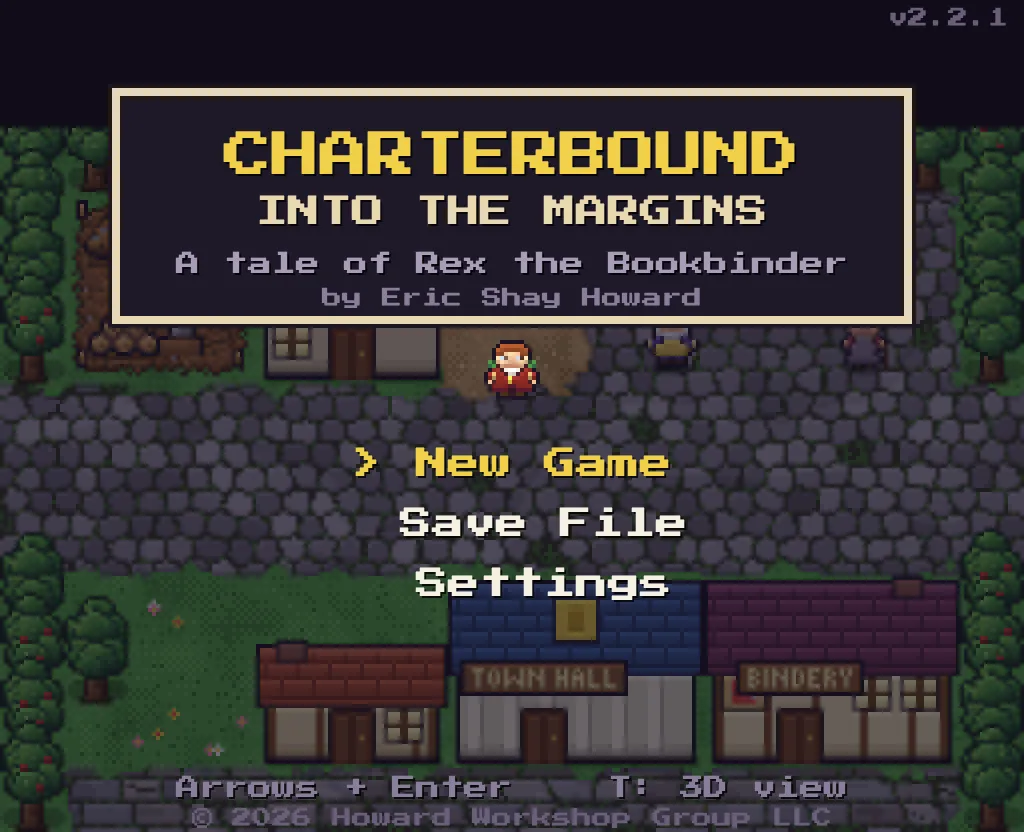
I didn’t do much of the actual writing of the story of this game. Through the recursive writing process, as I played the game, I decided what went, what to change, and what direction to go next.
I loved dungeon crawlers and RPGs when I was younger; I played the heck out of Zelda growing up. I also enjoyed simulation games like The Sims and Civilization when I was a teenager. Between college, two terminal degrees, and teaching, I haven’t had time to play many since. So at first, I didn’t care what the game looked like, or even what its story was. I wanted the loop: go out, gather, come home, and make something.
Some nights I don’t have the energy to fight something, though, so you can also sit back and watch. Rex makes camp, and the camera roams the kingdom on its own, looking for what’s worth seeing: a raid at a town’s gate, a wedding, a night at the Tavern. A day in the game takes ten minutes, and nothing is waiting on me. If I put it down for a week, the towns are where I left them.
Still in the Workshop
I’ve started a couple more since, and neither is out yet. One is a spinoff of Charterbound that’s more modern and different: The Bindery Window, a bookbinder’s workshop generations after Rex, mostly watched through its windows, with the world going on outside.
You mostly watch and gently steer. Wren, the bookbinder, works through commissions at the bench, and you can send them out across the square for a loaf of bread, a parcel to deliver, or the Tavern’s gossip. Outside, the town lives its week: market days, children walking to school, the neighbors in their garden, the weather and the seasons, and houseplants that grow leaf by leaf.
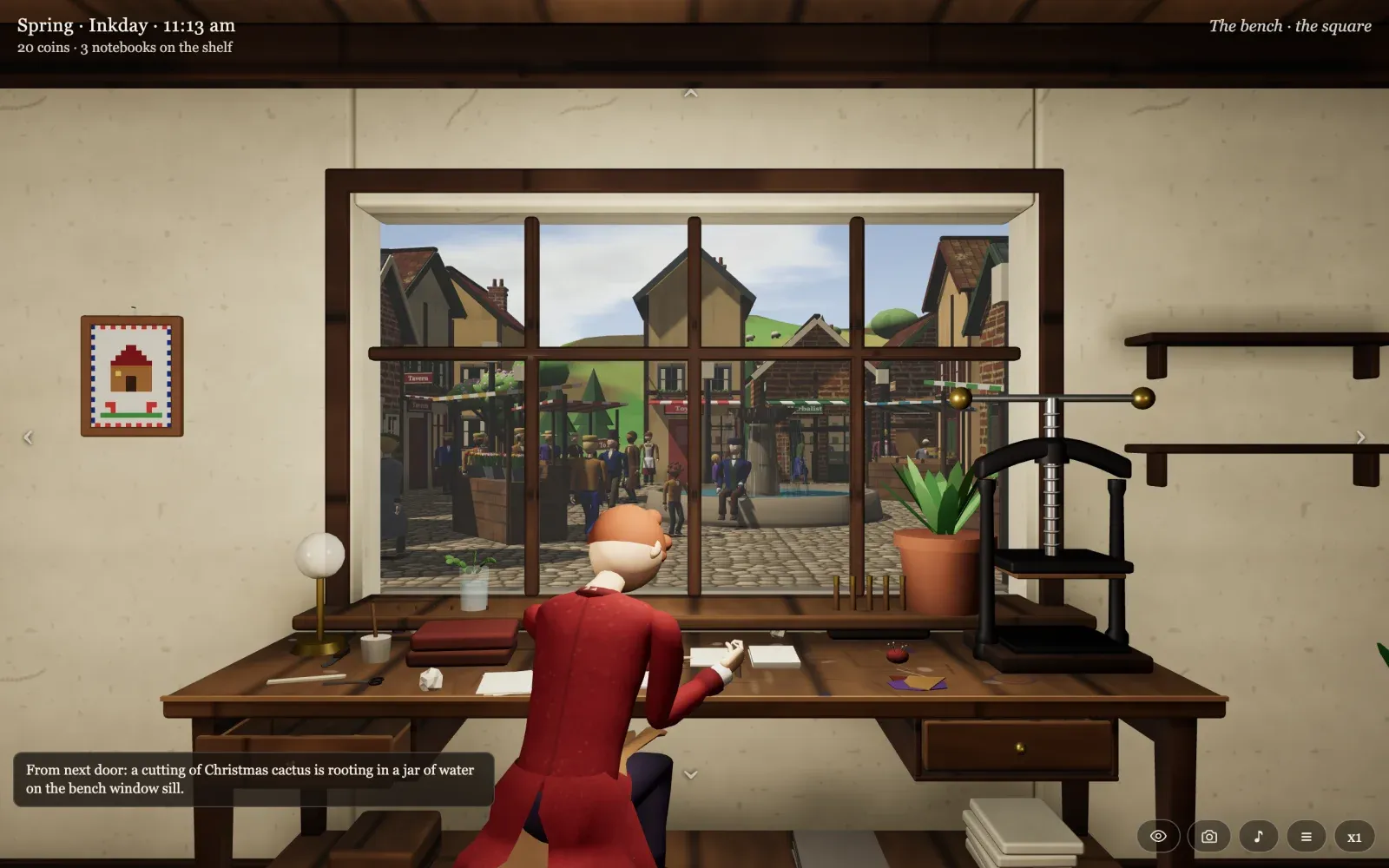
The other is Thursdays at Nine, a TV network game drawn like a PlayStation game from 1998. You run Campus Safety Alert, an over-the-top crime drama about a university’s campus security department, for the network that airs it on Thursdays at nine. You don’t play the officers; you run the show. Each week the writers draft an episode, and you can read it with the cast, cutting scenes and deciding how each one plays, or let it run as they wrote it. Then it airs, and you watch it. Between episodes, there are the ratings, the sponsors, and the actors and their contracts.
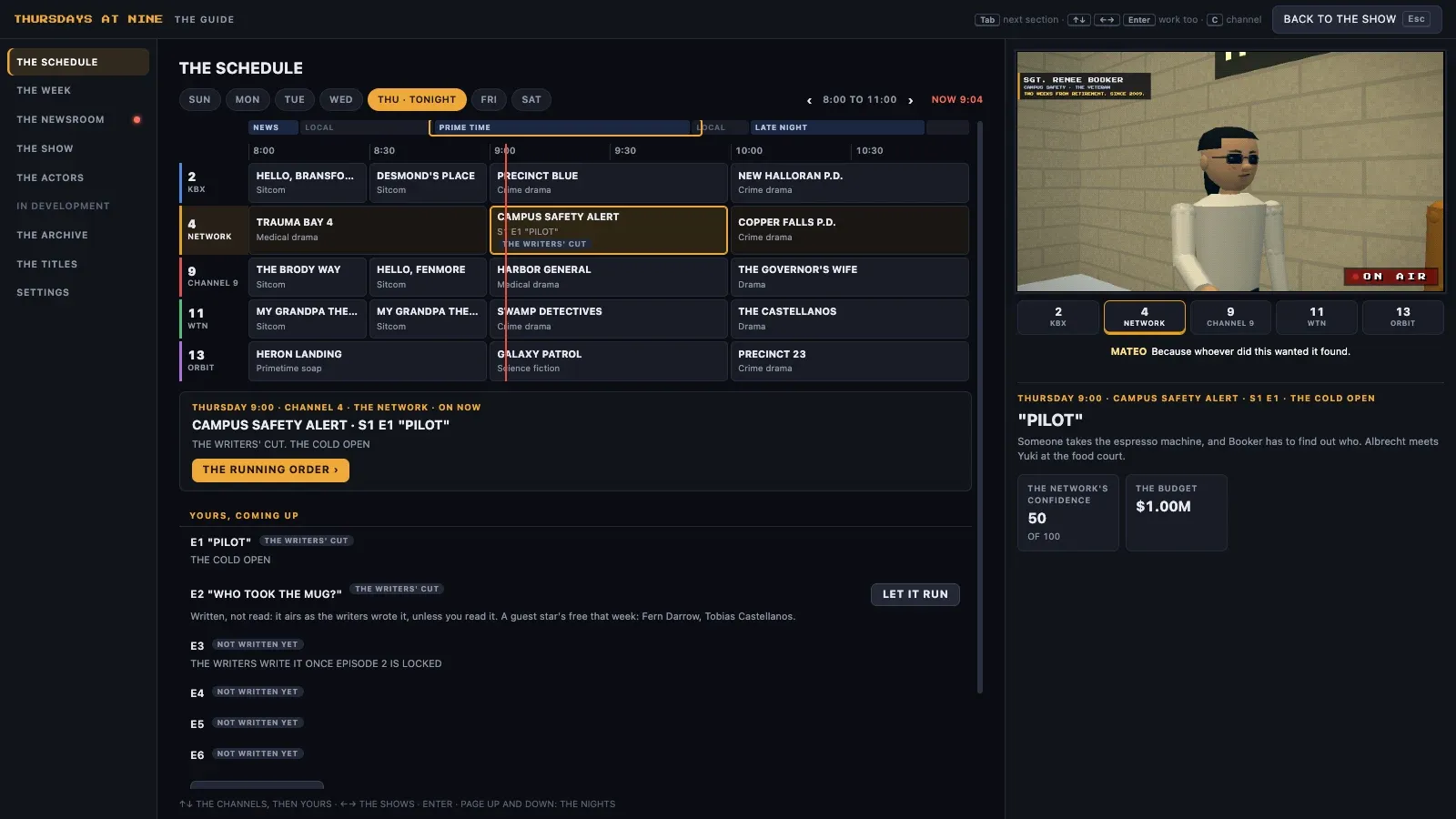
I’m still recursively thinking about both of them a lot, and they’ve been changing a lot as I’ve worked on them. I’ll release more details about them as they get closer to feeling finished.
In My Classroom
Last year, I was afraid of AI. I didn’t really understand it, and I had a big gap in my knowledge and experience with it. Now I’m much more open to letting students experiment with it, as long as they’re honest about it and cite it appropriately.
I can also teach the recursive writing process itself better now. Making these games put me through it again and again, with the AI on the other side. And I can model the process much more quickly in the classroom with AI if I need to. We can do quicker exercises on parts of it, which I hope increases students’ confidence in understanding the process, at the very least.
WPA Desk and Charterbound are both free to play in your browser.
Keep talking
Join the conversation
Replies happen on X. If you’d rather say something privately, email me. I read everything.