Essay number 7
Writing Doesn’t Have to Be Done the Hard Way
That’s what good creative tools do: take away the hard parts that are useless, but leave the hard parts that are useful.
Process: Co-writing9 rounds of revision
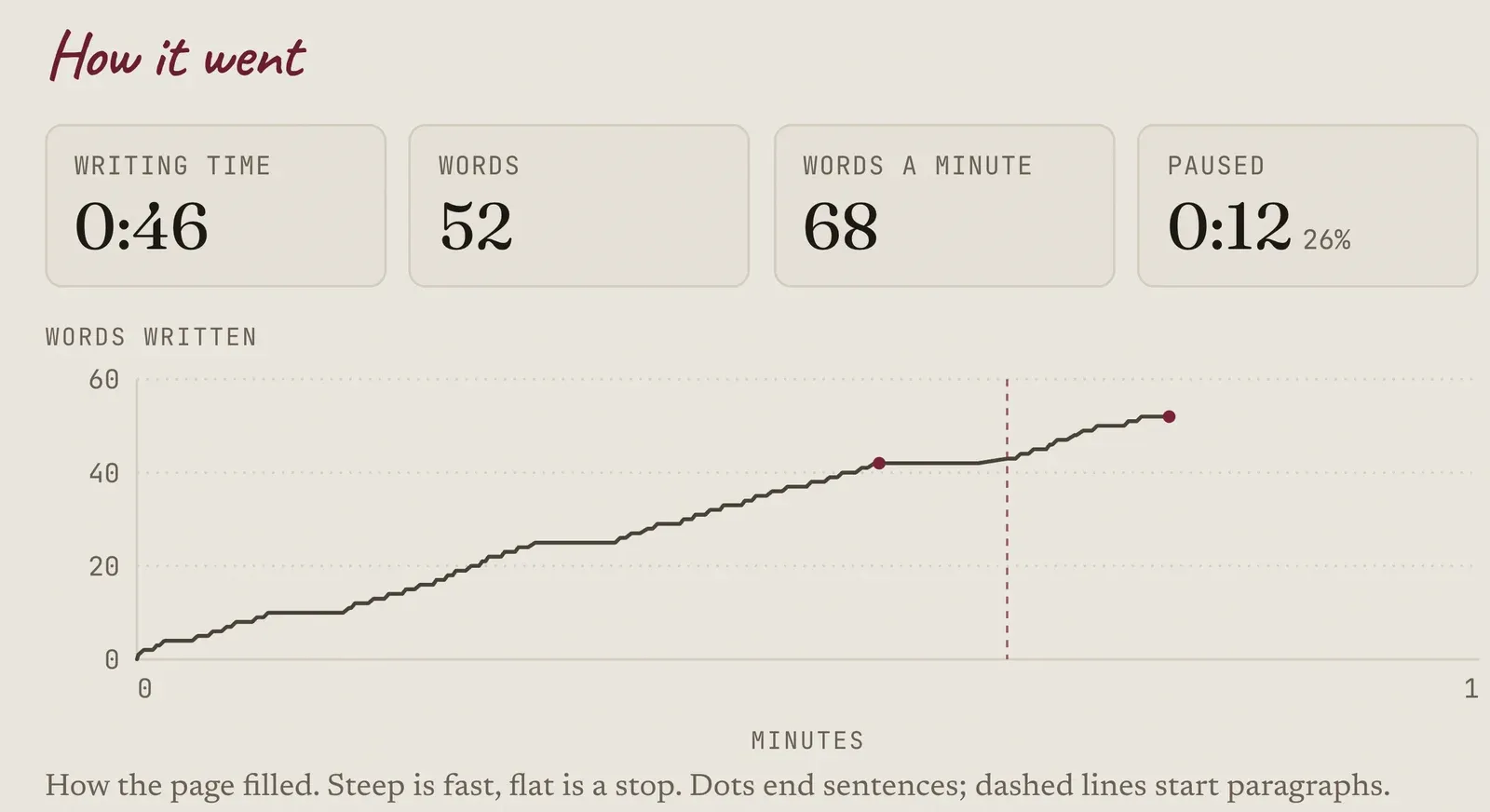
I made a freewriting tool for my English 101 students; it tracks data while they write, and at the end it gives them that data: how long they stopped, how much they wrote, how long their sentences were, and things like that. My real goal was to help them get primary data for their first paper in my class, the “autoethnography.” Over the semesters that I’ve assigned it, students really struggle with gathering that data for some reason, even though we go over how to do it in class discussions many times. The assignment sheet itself lists plenty of options for gathering their data: they can do a screen recording, they can record themselves reading out loud, they can cite previous drafts or notes, and nearly anything else they can think of that shows their meaning-making process. This semester, I even included an activity in a lecture that had them record their screens for five minutes while they did some simple freewriting in Microsoft Word or Google Docs, or even on their phone.
For whatever reason, many students just don’t cite any data in this assignment, and I’m not sure why. So, I turned to Anthropic’s Claude with an idea: I asked it to create a freewriting activity on my website, then I had it add the analysis tools to give the user data for the autoethnography assignment. Most students have a computer, but some used their phones. It also works on mobile, so even the students that typically don’t bring their laptop engaged in the freewriting. My hope is that the charts they get from the tool are quicker to look at and probably easier to work into a paper than analyzing a bunch of recordings.
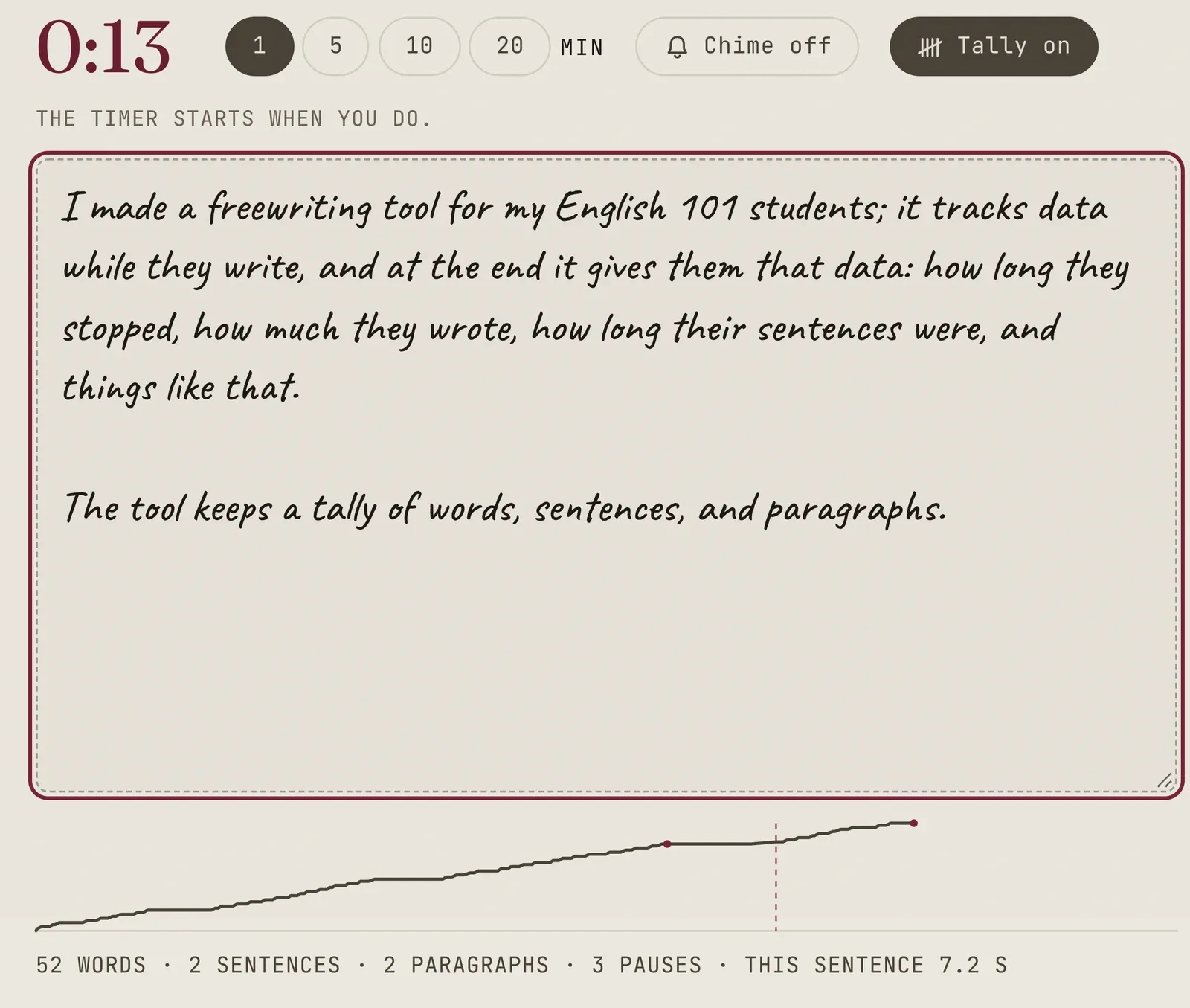
The tool keeps a tally of words, sentences, and paragraphs as well. While trying the activity myself, when I saw the tally, I noticed that I actually spaced out some paragraphs in the moment instead of writing one big long paragraph for five minutes. I even deliberately tried to write longer and shorter sentences a few times, which was not something I’ve consciously paid much attention to in the moment for a long time, even after an MFA. It’s got me thinking about these things so much that now I’m actually kind of worried that the data is too distracting for some students who just want to freewrite; the whole point of freewriting is to not think too much about structure or even sentence length while you’re just trying to get ideas out of your head. I can’t tell yet whether I’ve found a happy medium or overdone it. So, I made the tally and data tools something students have to flip on.
How much should a tool do while someone is writing? With the data on in my tool, I worry it makes them think too much about the mechanics. With AI involved in the process, the worry is the opposite, that it hinders the thinking people do. But I think students may feel that gathering data for my autoethnography assignment is hard in a useless way. Maybe freewriting is hard in a useful way. So students do what’s useful for them. That’s what good creative tools do: take away the hard parts that are useless, but leave the hard parts that are useful.
AI is a tool that can be used both ways. My goals in the classroom as AI comes up in our conversations are to help students navigate this same useful versus useless hard. Writing is hard, and so is learning to use AI within the writing process as opposed to as a replacement for it.
And now that I’m building more internal writing and revision tools with the help of AI, I think even more about my own writing process. I’ve been saying that AI is compatible with the writing process until I’m blue in the face, but many still see any sort of AI use within the process as tainting the work; I don’t agree. When used as a part of the process, these tools help us think; they don’t replace the thinking. I still had to think about my tools and get them to do what I wanted them to do; I had to think harder about the tool and less about the coding. A student with an understanding of audience and purpose that uses AI as a step in their essay of many drafts and recursive edits also must still think. They just might not have to type as much. The crowd that sees any sort of AI use in the process and a one-to-three-shot AI-prompted paper as the same, “100% AI-created,” needs a reality check.
Writing was never natural; humans don’t come out of the womb ready to write a story. We have only been writing in the way we do now for about 5,000 years. And writing is hard. But it doesn’t have to continue to be done the harder way just because those of us who learned to write before ChatGPT had to learn to write the difficult way.
As an MFA in Creative Writing degree holder myself, and as a writing professor, I don’t want to get left behind without the tech and AI skills I need down the road. I’m having a great time creating and improving my own tools and the activities on my website for my students with the help of AI. My hope is that students and people in the workforce recognize that writing is still an important skill, but that AI can help make both the thinking and the writing process so much easier. And I don’t want to do things the harder way just because it’s the way I and others had to do it for a long time, not when there’s an easier way, or, dare I say, a better way. And I don’t want others to have to learn to do things the harder way if they don’t need to.
I think next semester, I’ll actually start the conversation in the classroom: what about learning to write so far has felt like “useless hard,” and what has felt like “useful hard”? And I’m sure I’ll get all kinds of different answers as we all try to figure this out together.
Keep talking
Join the conversation
Replies happen on X. If you’d rather say something privately, email me. I read everything.